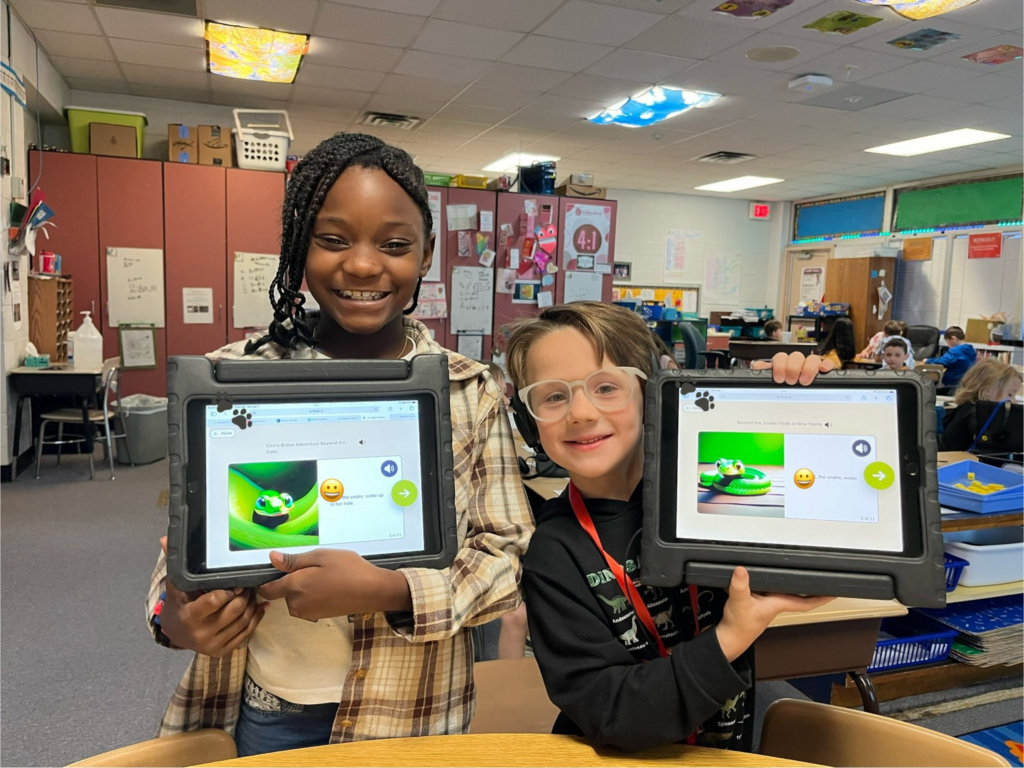
Young readers build fluency by reading aloud and getting feedback, but a K–2 teacher can only listen to one child at a time. LitLab is designed to close that gap: students record themselves reading phonics-matched stories while its AI tool scores their accuracy and speed, and teachers see the results on a dashboard.
In an independent study funded through Accelerate’s Call for Effective Technology (CET) program, K–2 students in an Arkansas school district whose teachers used LitLab scored higher on the state literacy test than similar students, achieving about two to three months of reading growth above typical levels. Although the large effect size over a relatively short implementation period warrants further study, this is a promising result.
What was the study?
Researchers from SETA-ED conducted a quasi-experimental study (QED) in K–2 classrooms at nine Arkansas elementary schools during the 2025–26 school year. Eighteen teachers volunteered to participate in the study, and students whose families opted in used LitLab from January 7 until state testing began on April 14, just under 14 weeks.
Students weren’t randomly assigned, so researchers matched each LitLab student with a similar student in another classroom, using a fall reading screener and background data. They later compared students’ spring scores on ATLAS, the state literacy test, which neither LitLab nor the researchers designed. The researchers registered their analysis plan before seeing any results.
What did the study find?
LitLab students scored 6.38 points higher on the spring test than their matched peers, an effect size of 0.38 standard deviations (95% confidence interval 0.15 to 0.60; p = .002), roughly equivalent to two to three months of additional reading growth.
- More practice was associated with higher scores, up to a point. Scores rose with total recorded reading time up to about 33 minutes, then leveled off. But students in the same classroom tended to practice similar amounts, so it is difficult to separate the effect of practice from the effect of the teacher. Students whose teachers spent more time using LitLab’s dashboard didn’t consistently score higher.
- The AI scored reading reasonably close to human raters. Across 200 recordings, LitLab’s scores differed from the average of two human raters’ scores by 6.7% on average, while the raters differed from each other by 3.1%.
- LitLab’s fluency scores aren’t a substitute for a screener. A reading rate the researchers built from LitLab’s practice data tracked the state test only moderately (r = .52), as they expected for short, untimed practice texts. A high score was a good sign, but a low score could reflect a soft voice or a noisy room rather than weak reading.
- Teachers liked it. In LitLab’s final survey, 69% of responding teachers said they’d be very disappointed to lose it, although it is important to note that these results were among teachers who had volunteered to use LitLab in the first place.
How confident should we be?
The direction of the result is credible; its size is less certain. Studies of reading technology average an effect of about 0.16, and this one had an effect size more than twice as large, from a supplemental tool used about half as much as planned. In the researchers’ words, the result “warrants scrutiny before it warrants confidence.”
- Volunteer teachers may be stronger teachers. Teachers who opted into the study may already give more reading practice and feedback, and the study had no teacher data to adjust for that. Families who opted in may also read more at home. Both would push the estimate up.
- Students’ starting points are imprecise. The only available fall score was a two-level rating, “ready” or “at risk,” so matching couldn’t ensure students started at closely aligned reading levels.
- The originally planned outcome didn’t show a clear gain. The registered plan used scores on specific reading skills, which differ by grade, so the researchers switched to the overall test score to combine grades. On the skill scores, all nine estimates were positive, but none was statistically significant after adjusting for the number of tests, though the samples were too small to detect small or moderate effects.
Who participated in the study?
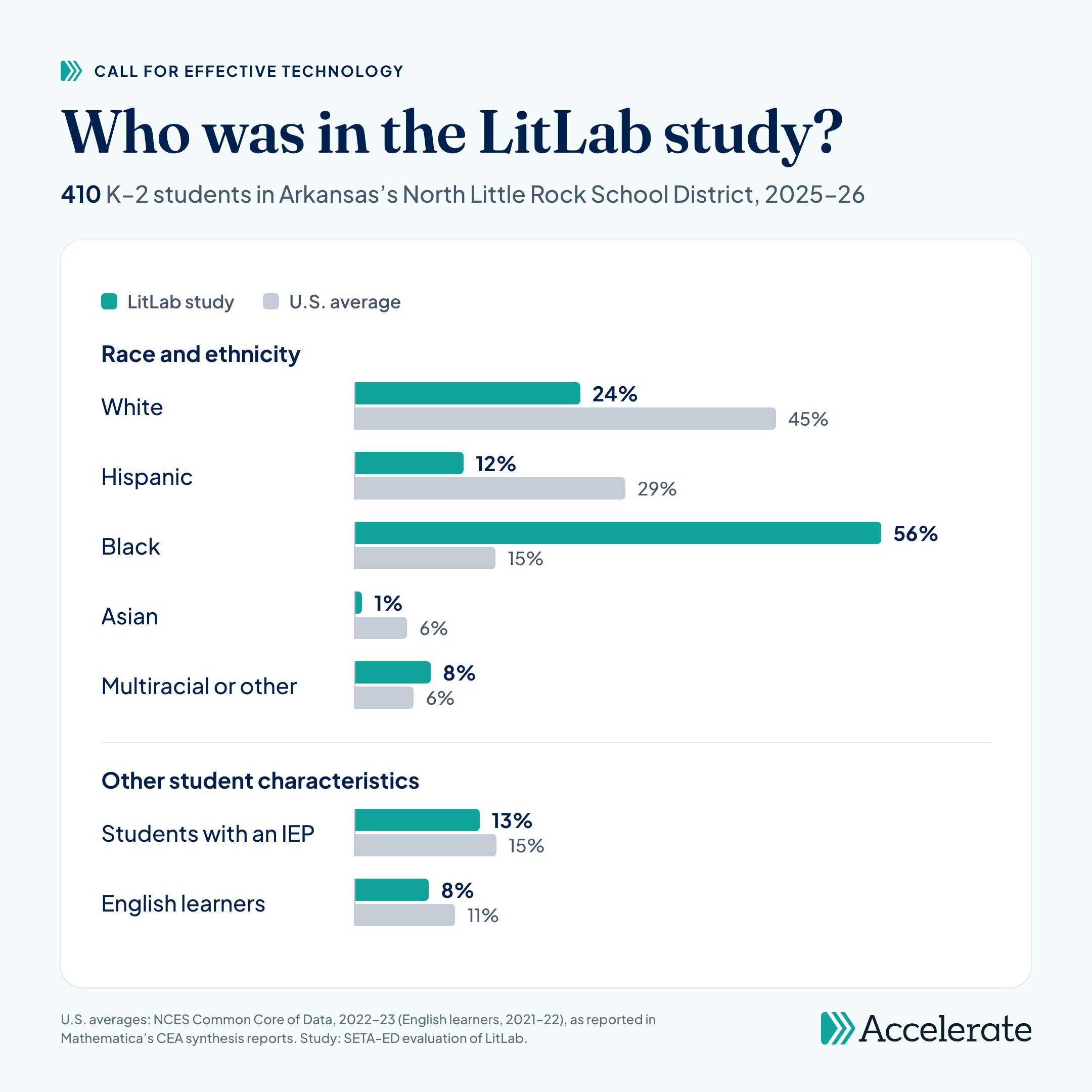
The analysis included 410 K–2 students in 41 classrooms: 208 in LitLab classrooms and 202 matched peers. The participating district is a high-poverty, majority-Black district; about 56% of students in the sample were Black, 24% were White, and 12% were Hispanic. Thirteen percent had IEPs, and 8% were English learners.
Eighty students who used LitLab (about 27% of the LitLab group) had no close match and were left out of the analysis. These students were mostly White second graders, so the effect applies to students who were younger and more often Black than LitLab users overall. Results didn’t differ clearly by grade, gender, race, English learner or special education status, or starting level, but those tests could detect only large differences.
What did implementation look like?
Most teachers ran LitLab at centers or in small groups while they worked with other students, and a few used it with the whole class at once.
Students used LitLab about half as much as planned. The median student logged about 255 minutes in total, roughly 18 to 20 minutes a week against an initial plan of 30 to 40. Sixty-one percent of students met a lowered target of 15 minutes a week for at least six weeks.
The study offers several important lessons for future implementations:
- Plan for practice to happen. Students got about half the planned practice time. Practice time should be built into the schedule, and usage reports should be tracked to catch students who fall behind.
- Measure where students start. A simple “ready” or “at risk” rating in the fall was insufficient to confirm that matched students began at closely aligned reading levels. Future studies need a more detailed baseline score.
- Use a reading screener, not LitLab’s scores, to find struggling readers. A reading rate built from LitLab’s practice data tracked the state test only moderately.
- Budget for teacher time. LitLab emailed teachers weekly usage reports to help keep students practicing, but these reports only help if teachers have time to read and act on them.
What comes next?
A randomized trial, assigning classrooms by lottery, would put volunteer teachers on both sides of the comparison and distinguish how much of this result came from LitLab itself rather than characteristics of the teachers who chose to use it. It could also compare small-group or center use with whole-class use and include more English learners.
Like our Goblins study, this evaluation offers a promising result, and marks an important contribution to the evidence base on AI in classrooms that CET is helping to build.
About the Call for Effective Technology (CET)
Through our Call for Effective Technology (CET) grantmaking program, Accelerate commissioned independent evaluations of AI-powered educational tools during the 2025–26 school year. The studies in our first CET cohort collectively involved roughly 21,000 students across 14 states, tested tools under real classroom conditions, and used quasi-experimental designs. Our second CET cohort includes 11 grantees working across 45 states, with several running randomized controlled trials.
These tools are evolving faster than typical research timelines, so we are sharing results as quickly as possible. Timely evidence helps providers identify what to improve and gives education leaders better information for their purchasing decisions. We’re grateful to the providers and districts that took part and committed to sharing the findings publicly, whether they are encouraging, disappointing, or inconclusive. These studies will not definitively settle the debate about AI in classrooms, but they represent an important step toward understanding which tools help students learn and under what conditions.
CET STUDY RESULTS
- Can an AI Tutor Help Middle Schoolers Learn Math? What a Study of Goblins Among 6,000+ Students Found
- Can AI Help Students Write Better? What a Study of EnlightenAI Taught Us
- Can an AI Conversation Partner Help English Learners Build English Proficiency? What a Study of IMMERSE Found
- Can an AI Tool That Listens Help Young Children Learn to Read? What a Study of LitLab Found