
Giving feedback on a single middle or high school essay can take a teacher 20 to 25 minutes, which makes writing one of the most time-intensive grading tasks. And, crucially, it is also an area where underserved students get markedly less focused development than their more advantaged peers.
An independent study funded through Accelerate’s Call for Effective Technology (CET) grant program tested whether EnlightenAI, a revision-focused, teacher-calibrated feedback tool, could help AP U.S. History students at Uncommon Schools learn to write better. The results were inconclusive. Students offered the tool scored about the same on the AP exam as those who were not offered it, and limitations in the study’s design mean we can’t say whether the tool made a difference.
A clearer lesson is that adoption doesn’t guarantee a tool will be used as intended. Nearly every student offered the tool logged in to the platform, but from September through March, revision with the tool’s feedback rarely happened. No student revised more than one assignment with the tool’s feedback, well short of the six to eight revisions anticipated. Making regular revision part of how the tool is used in class is where the next implementation has to start.
What was the study?
Researchers from SETA-ED conducted a quasi-experimental study (QED) of AP U.S. History classes at nine high schools in the Uncommon Schools charter network during the 2025–26 school year. Five used EnlightenAI and four did not. In those five schools, teachers used EnlightenAI to collect and grade written assignments, and students received its feedback either immediately or after teacher review.
The researchers compared students offered EnlightenAI with similar students in the comparison schools on a spring writing test and the AP exam. Students were matched on prior test scores and demographics.
The study had serious limitations, and the researchers characterize its findings as “suggestive, at best.” Whole schools either used EnlightenAI or didn’t, so the comparison came down to five schools against four. Hundreds of students took part, but a school-based comparison meant that the study effectively had nine data points. As a result, EnlightenAI would have to be at least three times as effective as a typical education program for the study to reliably detect a difference.
What did the study find?
All but one of the 329 students offered the tool logged in, and together they submitted nearly 5,000 assignments over the year. Teachers reviewed EnlightenAI’s suggested grade on about four in five of them. But the tool was designed to drive revision, and that step almost never happened. Students primarily used the tool to turn in their work, not to revise it in response to feedback.
Scores on the spring writing test and the AP exam were about the same in schools using Enlighten AI and comparison schools. In the researchers’ words, the study “cannot distinguish a tool that does not improve writing from a tool that was not used as designed.”
Who participated in the study?
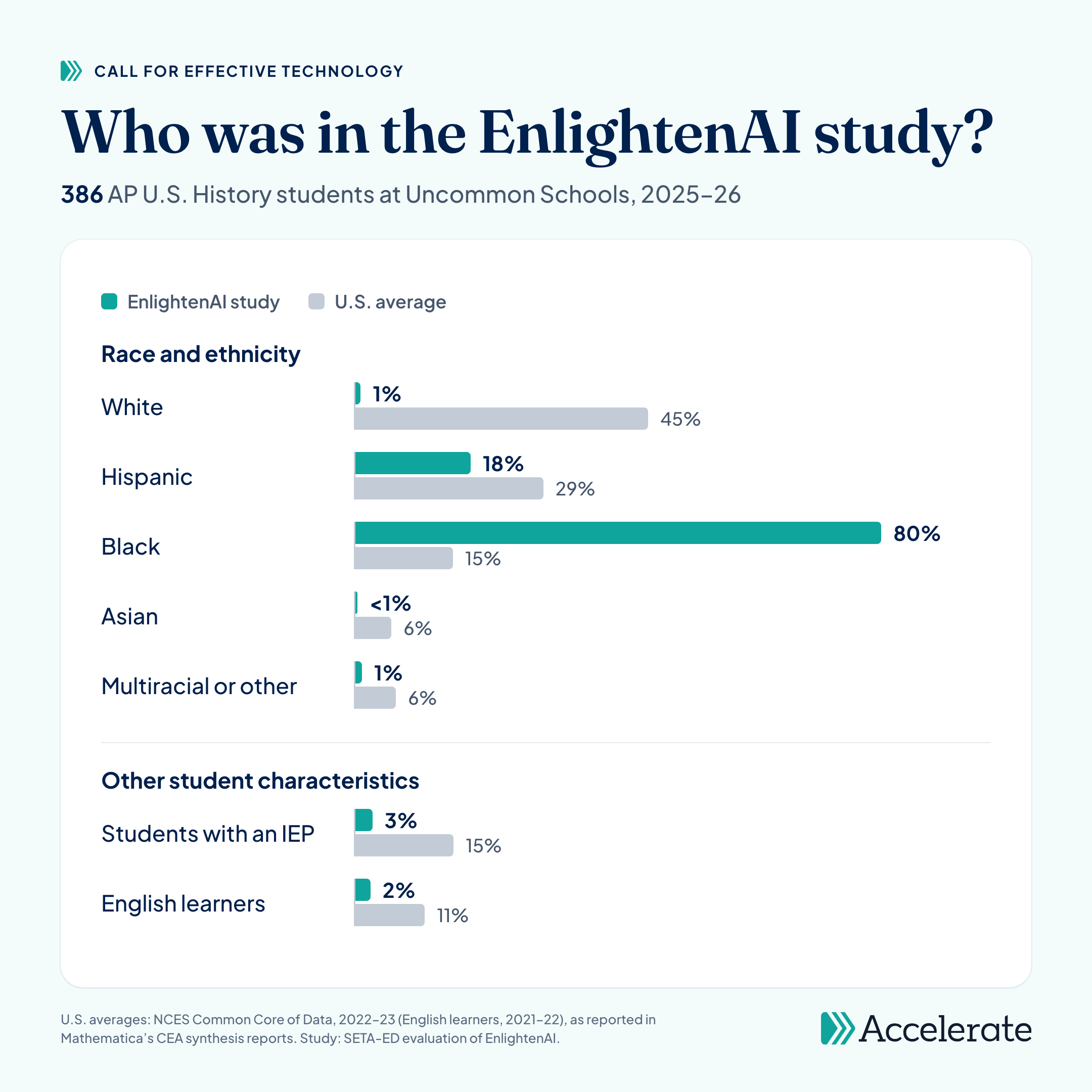
Uncommon Schools is a nonprofit charter network serving about 20,000 students in New York, New Jersey, and Massachusetts, 84% of whom are economically disadvantaged. Uncommon reports that 96% of its graduates take at least one AP exam, compared with 37% of U.S. public high school graduates. About 600 Uncommon students, mostly 11th graders, were included in the study. Of the students who used the tool, roughly 80% were Black and 18% Hispanic or Latino. Nationally, Black, Hispanic, and Native American students make up about 38% of AP test-takers, so this study brought a new writing tool to students who are underrepresented in AP classrooms.
What did we learn for next time?
- Make revision part of the routine. Revision doesn’t happen on its own. In a separate recent study of 937 secondary students who received automated feedback, one in five didn’t revise at all. The next implementation should build time for revision into lessons and check that it’s actually happening.
- Watch for the intended use, and act early when it’s missing. Providers, schools, and researchers should agree up front on what intended use looks like and change course when it isn’t happening. If students keep using a tool differently than planned, that evidence should guide what the provider builds next.
- Design the study to answer the question. That means constructing a large enough sample at the level where the tool is assigned whether schools, classrooms, students, or another unit. It also requires a baseline measured before anyone uses the tool, and at least one outcome measured independently (such as AP scores).
- Gather the data that explains the results. Testing a new product is worth the time and effort when the study is designed to provide insights regardless of the study outcome. In this case, collecting multiple drafts and surveying students and teachers would help us learn what happened after feedback was delivered. Without that information, part of the story is missing: we don’t know whether students read the feedback or had time to revise, or how teachers used the suggested grades. Future studies should plan for this kind of data collection from the start.
These lessons apply to any AI feedback tool, not just EnlightenAI, and to any school, researcher, or funder testing one, including Accelerate. Research on AI tools in classrooms is still in its early days, and studies like this one, which test what happens under real conditions, help the field learn how to evaluate these tools well. But even in the best circumstances, a better writing process may not show up on high-stakes tests. In one randomized trial, AI feedback improved the essays tenth graders revised, but the gains didn’t measurably carry over to a new writing task. Studies of these tools should track progress on revised drafts as well as test scores, so that writing process improvements don’t go unnoticed.
What comes next?
The next evaluation of EnlightenAI can build on these lessons, starting with a short study of why students didn’t revise and how to change that, before another test of whether the tool moves scores.
Good writing is iterative. Revision is a process of discovery, where writers sharpen their thinking along with polishing prose, but researchers have long found that novice writers treat revision as little more than fixing words. Tools like EnlightenAI could make the personalized feedback that motivates meaningful revision possible at a scale no teacher can manage alone. We look forward to seeing how EnlightenAI, and the research examining it, evolves.
EnlightenAI deserves credit for agreeing to publish the findings before anyone knew what they would show, and we are grateful to Uncommon Schools for opening its classrooms to be part of this study. Both organizations showed a clear commitment to student learning and a desire to use evidence to improve outcomes. The field needs more partners willing to follow their lead.
Good writing rarely comes together in a first draft, and when it comes to studying emerging tools, the same may be true for early research.
This study is worth highlighting because it shows what needs to happen next. Acting on that feedback is now the work for EnlightenAI, researchers studying tools like it, and for Accelerate, as we continue to fund research on AI tools and help the field learn how to evaluate them well.
About the Call for Effective Technology (CET)
Through our Call for Effective Technology (CET) grantmaking program, Accelerate commissioned independent evaluations of AI-powered educational tools during the 2025–26 school year. The studies in our first CET cohort collectively involved roughly 21,000 students across 14 states, tested tools under real classroom conditions, and used quasi-experimental designs. Our second CET cohort includes 11 grantees working across 45 states, with several running randomized controlled trials.
These tools are evolving faster than typical research timelines, so we are sharing results as quickly as possible. Timely evidence helps providers identify what to improve and gives education leaders better information for their purchasing decisions. We’re grateful to the providers and districts that took part and committed to sharing the findings publicly, whether they are encouraging, disappointing, or inconclusive. These studies will not definitively settle the debate about AI in classrooms, but they represent an important step toward understanding which tools help students learn and under what conditions.