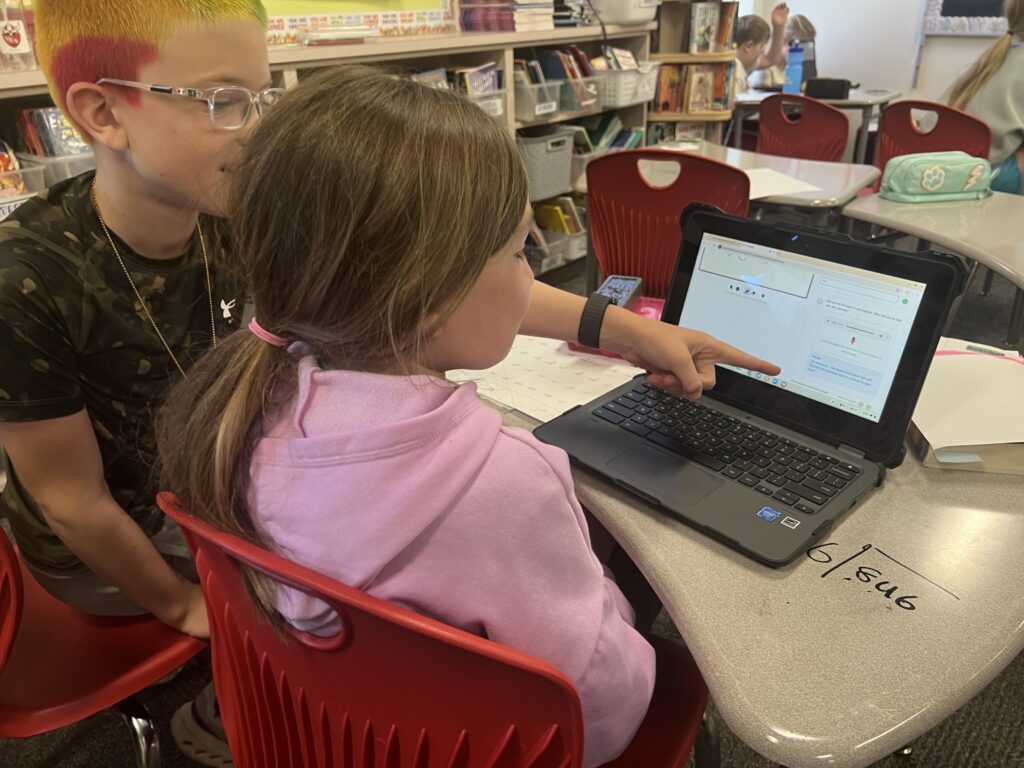
As we made our way around a middle school math classroom in the Midwest, we overheard a tutor prompt a seventh-grader to recheck her multiplication on the last few steps of an equation. She glanced at the student sitting next to her, unsure where she had gone wrong. The other student asked a leading question that helped her find where she’d slipped so she could fix the error and keep learning. Later in the day, while conducting a small focus group with tutoring participants, students told us directly that “tutoring gives [them] extra help” during the school day on math topics that they are confused about. Teachers separately shared that help sometimes comes from peers as different students build math skills and command of the material.
This year’s visits to see our grantees in action reaffirmed something we return to again and again: standing in a classroom teaches us granular lessons that build on high-level themes and data trends our grantees share in reports and dashboards. A grantee report showing math test scores climbing throughout the year is one promising piece of evidence that a tutoring program is moving the needle on student learning. Witnessing a moment of collaboration between students that sparks understanding adds depth to our understanding of a program’s impact on students’ growth, confidence, and connectedness.
Classroom observations are representative of our commitment to ensuring a bridge between evidence and action. Since 2023, Accelerate staff have visited schools across 32 cities in 19 states and the District of Columbia.
What made this year’s visits especially instructive was the variety of tutoring models we saw side-by-side, including in-person small groups, virtual synchronous tutoring, and an on-demand tech platform with an AI chatbot. Tutoring spanned elementary through high school but clustered in grades 6–8 math, most of it aimed at improving student outcomes on state assessments. A few themes emerged across all of them.
1. Virtual tutoring takes every bit as much intentionality as in-person models
Over years of visits, we’ve seen that in-person tutoring demands dedicated logistics: moving students to the session, securing the space where it happens, and carving out a slot in an already-crowded master schedule. Moving the whole thing onto a Chromebook doesn’t eliminate that work. Instead of making sure a human tutor has a table and chairs in a quiet corner, you now need computers with chargers, headphones, microphones, and cameras, set up where the Wi-Fi signal is strong and the room is neither too loud nor too quiet. The intentionality required is the same; only the checklist is different.
The clearest example came from a teacher at one middle school who had figured out, through trial and error, the fastest way to get her tutored students online and working: a backpack hung on the back of each student’s chair, pre-stocked with headphones, a whiteboard, a marker, and an eraser, with those students seated apart from the rest of the class. That one routine was the difference between a session starting in thirty seconds and one that ate up five minutes of instructional time.
2. Adult buy-in, like many things in PK–12, unlocks student buy-in
As with so much of what we see in classrooms, the adults set the temperature, and students tend to follow.
The sharpest contrast came from seeing the same grantee program in two different middle schools on the same day. At one, the principal framed students’ participation as a contribution to something larger — to the research community, to the field — and the kids leaned in. A few miles away, a teacher described the decision about who received tutoring as “not my call,” and his students (many of whom acknowledged tutoring was helping them) were the least convinced they needed it. The tutoring was the same; the framing around it wasn’t.
Grantees tell us all the time that administrator and teacher buy-in is essential, but a written summary can only tell us that it mattered. Being in the room shows us why: we watched a single adult’s framing ripple into whether students leaned in or held back. Where the adults are all-in, it gives students permission to be all-in, too. These insights are already shaping how we support our next cohort of grantees in the 2026-27 school year, particularly the messaging they share with their district partners that inevitably shapes teacher and student buy-in.
3. Finding tutors is a surmountable challenge, even in secondary math
A full day on-site lets us talk to a much broader set of people behind these programs. At every site visit, we sat down with tutors in focus groups or in one-on-one conversations about why they took the job and what it actually demands, and we also watched them deliver sessions.
What we heard and saw suggests that tutoring talent doesn’t have to be an impossible hurdle for these providers, even the ones delivering upper-grade math. That’s notable given that math is among the most persistent teacher-shortage areas in the country; roughly 40 states name this as a challenge. Finding adults who can teach these concepts well is no small feat.
And yet this grantee had found a way through. They were sourcing capable tutors through real vetting: having candidates teach a demo lesson before hiring, and drawing on both certified teachers and skilled non-certified hires. We observed tutors with genuine command of difficult material and, just as important, concrete techniques for questioning students and drawing out their thinking. Some tutors were later hired into full-time teaching roles in the very schools and districts where they tutored. Neither that skill nor that pipeline shows up in a fidelity report.
As a team dedicated to translating evidence into action, we will always look forward to visiting schools to connect with the teachers and administrators doing the tough work of implementation and meet the students we aim to serve. Time in schools and classrooms add valuable color to the data and diligent reports shared by our grantees. We’re grateful to the grantees, educators, and students who welcome us in.
Jennifer Bronson is Managing Director of Learning Programs and Aidan O’Donnell is Program Coordinator at Accelerate.