In our reflections from Accelerate’s Annual Convening, we noted that the field has moved past debating whether tutoring works. The real questions now are about driving up dosage, improving our understanding of cost, and finding sustainable ways to embed tutoring into how schools do business.
The Evidence Has Caught Up
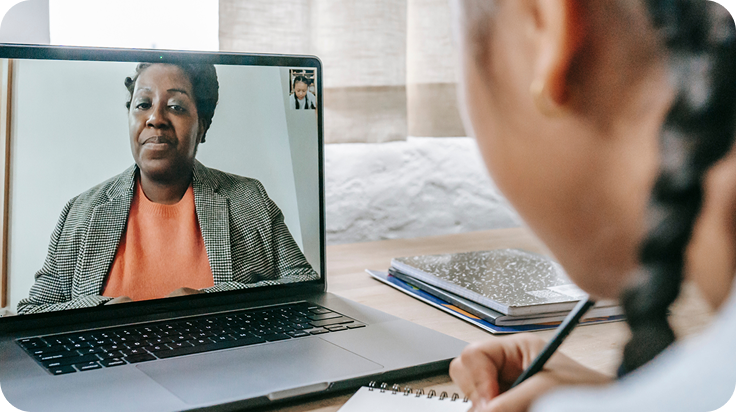
Virtual tutoring is an important part of learning how to do just that. Accelerate’s new Synthesis Report shows how quickly the evidence on virtual tutoring is catching up. Students receiving virtual tutoring – live instruction delivered by a human tutor online – produced effects comparable to or exceeding in‑person models, including for older students and in math. Air Reading (literacy, grades K-6) and Off2Class (literacy, grades 6-12, multilingual learners) are two examples of virtual tutoring providers with large, statistically significant improvements. The report also keeps us honest: these comparisons are descriptive, not proof that virtual delivery caused bigger effects. The takeaway is not that virtual is better than in-person. It’s that modality likely matters less than we previously thought and less than the ability to implement well and deliver dosage.
Virtual Tutoring Means More Reach
Why is this a big deal? Reach. Virtual tutoring widens the tutor pool beyond local hiring constraints, which matters most for rural districts and communities where recruiting enough tutors is hardest. We are excited that Accelerate’s new EIR grant in partnership with Oklahoma will test virtual and in-person tutoring at scale and directly examine design choices like group size and dosage. This is in addition to other RCTs in the field including Accelerate’s grantee Math-A-Matics that investigates virtual vs in-person vs non-tutoring business as usual.
Early Visibility Into Cost
We are also learning more about cost, not just outcomes. Using Accelerate’s cost tool, Air Reading’s evaluation estimates a per-pupil cost of about $1,500 from the school perspective, and roughly $1,700 from a “cost to society” perspective. These early estimates land at the low end of previously cited tutoring cost ranges. As more programs report costs using comparable methods, policymakers will have better information to weigh tutoring, of any modality, against other interventions competing for the same resources.
Challenges Are Real, But Not Disqualifying
Qualitatively, many educators describe virtual lessons as easy to use and even fun. But the drawbacks are real: audio issues, classroom noise, student disengagement, and concerns about screen time, which can erode dosage and the quality of the tutor-student relationship. Naming these challenges is part of building stronger models. It’s important to note that many of these challenges are not unique to virtual delivery. They are implementation challenges. And they underscore the same lesson we’ve learned about in-person tutoring: continuous improvement, effective management, and data visibility matter to success.
This Is What Building Evidence Looks Like
A special shout out to OnYourMark for their courage in going first. They evaluated early, honestly, and publicly, and helped the field learn faster. That is a courageous thing for any organization, especially a startup, and the field would not be here without them. They are still learning and improving, with another RCT in the field this year. Five years ago, many of us genuinely did not know whether tutoring would lose its special sauce when mediated by a screen. Today, we are in a different place: we have growing causal evidence, a deeper understanding of the optimal use cases, and a clearer view of what it will take to make virtual tutoring both effective and sustainable.
Luke Kohlmoos is Managing Director of Strategy at Accelerate.